Follow the reluctant adventures in the life of a Welsh astrophysicist sent around the world for some reason, wherein I photograph potatoes and destroy galaxies in the name of science. And don't forget about my website, www.rhysy.net


Monday, 17 October 2022

The Cosmology of Middle Earth (II) : Men and Monsters

It's time to continue with my series I probably should have titled Why I Love Tolkien So Damn Much. I'm looking at how Tolkien gives his work a sense of epic myth in part by drawing on cosmological-scale themes, drawing fundamental properties of the universe down into the smaller realms of everyday life.

Last time I began by looking at the Rings as symbols of corruption, but perhaps more importantly Narsil, the sword that cut the Ring from Sauron's finger. Glowing with the light of the Sun and Moon, its greatest deed was only wrought when it was broken and its light lost. Beauty, according to Tolkien, is not at all necessary for goodness, and sometimes the quality is wholly ambiguous : a fiery sword can be a thing of moral virtue but fire is also used in the defence of evil. We also saw that evil characters can feign beauty and use it to flatter and deceive.

Clearly, Tolkien's stories are a lot more complex than they're often given credit for. They are not Hollywood tales of knights in shining armour, even if they do sometimes charge to the rescue atop a white horse. They have grit and muck and gore, and Tolkien thought very carefully indeed about the characteristics he gave to each and every being.

In this second part, I'll up the scale of things just a notch to look at a selection of the denizens of Middle Earth. I'll continue examining the complexity of beauty in Tolkien's world and start to look at how these beasts and beings can embody forces much larger than themselves.


2) Men and Monsters

Lúthien  

Very little good artwork exists of the this part of The Silmarillion. This book cover is sort-of okay, apart from Juan's demented expression.

Among the tales of sorrow and of ruin that have come down to us from the darkness of those days, there are yet some in which amid weeping there is joy, and under the shadow of death, light that endures. And of these histories most fair still in the ears of the Elves is the tale of Beren and Lúthien.

So begins one of the most epic tales in one of the most epic works ever written, a pinnacle of romantic heroism, full of monsters, vampires, werewolves, a story so grand that even the Spanish-speaking superdog and – yes, seriously – an actual singing contest with Sauron doesn't diminish its mighty accomplishment. But I must carefully restrict myself, lest I wax lyrical and forget what my point was.

Lúthien certainly has the true-sort of beauty, the light of the Eldar. Her power is great enough to contest with the will of Morgoth himself, rendering itself in ways sometimes small and sometimes great. 

There came a time near dawn on the eve of spring, and Lúthien danced upon a green hill; and suddenly she began to sing. Keen, heart-piercing was her song as the song of the lark that rises from the gates of night and pours its voice among the dying stars, seeing the sun behind the walls of the world; and the song of Lúthien released the bonds of winter, and the frozen waters spoke, and flowers sprang from the cold earth where her feet had passed. 

Note that last. Flowers may seem a small thing, but mean that Lúthien can create life – a divine power ! At times it almost feels as though beauty itself is a power in the world, but this is not so. Rather beauty – true beauty – flows from Lúthien's goodness. Her song can alter the very seasons, making her ability to overthrow a mere fortress a trifle by comparison.

Then Lúthien stood upon the bridge, and declared her power : and the spell was loosed that bound stone to stone, and the gates were thrown down, and the walls opened, and the pits laid bare.

The use of song echoes the cosmology of the Silmarillion at its most fundamental level. Song was how the world itself was created, which I'll return to only at the end. Through song Lúthien connects to the Valar, the powers that govern the world, allowing ordinary actions to transcend to much higher levels. Tolkien captures what we feel should be happening when in the thralls of deepest emotions and gives it physical form. We can argue all day about the use of rhetoric and logic and correct persuasive argument, but those who think they can completely escape their emotional prisons are simply wrong. Tolkien instead chooses to embrace it.

And the singing contest with Sauron ? It could be meant literally, as in the famous ending to Zulu. Or it could be a metaphor for spells. Part of the appeal of Tolkien is that it's not always clear when he means to say something literally happened and when he's just using metaphorical imagery. More often than not, it's the former. Of course in this case songs could simply be used as spells; they're not always mutually exclusive.

To return to beauty, in a later tale Lúthien wears a Silmaril, and the effect is practically angelic.

It is said and sung that Lúthien wearing that necklace and that immortal jewel was the vision of greatest beauty and glory that has ever been outside the realm of Valinor; and for a little while the Land of the Dead that Live became like a vision of the land of the Valar, and no place has been since so fair, so fruitful, or so filled with light.

But even the beauty of the Silmaril, holding as it does the light of the Trees that preceded that of the Sun and Moon, is not itself pure and innocent. Lust for the Silmarils causes the ruin of uncounted elves : even these most beautiful of works of the elder days can corrupt, sometimes burning the hands of those who set upon them. It is only when they are paired with someone truly good, such as Lúthien, that their full power shines through. Beauty itself may sometimes seem like a force, but it is not : it is only ever a manifestation of moral intent. The effect it has depends on the minds of those who see it, rather than shaping those minds in itself.


Gandalf

Just a quick final example of how subtle beauty can be in Tolkien's writing. Everyone's favourite wizard is unarguably good to the point of saintliness, but he can also be dangerous and threatening. Just as beauty itself does not guarantee goodness, so Gandalf provides an interesting and unusual counter-example : a good character using darkness and menace for his own ends :

Or as written in the novel :

'Well, if you want my ring yourself, say so!' cried Bilbo. 'But you won't get it. I won't give my Precious away, I tell you.' His hand strayed to the hilt of his small sword.

Gandalf's eyes flashed. 'It will be my turn to get angry soon,' he said. 'If you say that again, I shall. Then you will see Gandalf the Grey uncloaked.' He took a step toward the hobbit, and he seemed to grow tall and menacing; his shadow filled the little room.

So yes, Tolkien has fairytale aspects of heroes who flourish the sword in such a way that it goes "ting" when the light hits it, of grace and elegance reflecting the inner virtues of their protagonists. But it's also not that simple. Evil characters can use feign glamour and style, and good characters can use darkness and intimidation. Tolkien's world does have simplistic elements of good-versus-evil, but it would be a mistake to think that's all there is to it.


The Nazgûl

While the forces of good can create life, the forces of darkness bring about death. One point Tolkien was quite emphatic about was that evil cannot create, it can only corrupt and destroy. Its effects are not easy to fully overthrow – indeed, that may be impossible. For example, after Éowyn and Merry slay the Black Captain and the fell beast on which he rides, the clean-up operation begins. Théoden's horse is buried but the Nazgûl's* corpse is burned :

* Strictly speaking the Nazgûl are the Ringwraiths, and the winged beasts they ride on are simply fellbeasts. However, this is because Tolkien foolishly insisted on giving fifty names for some things and one really stupid name for others. I prefer the convention of the movies, where the Nazgûl are the monsters. It's certainly an improvement when you realise that there are also fell ponies.

Green and long grew the grass on Snowmane's Howe, but ever black and bare was the ground where the beast was burned.

The effects of goodness and evil alike linger on. As Lúthien creates life, so does Snowmane's body  but so too does the body of the Nazgûl bring death even after its own end. Such a creature that continues killing even beyond its own demise is a frightening prospect indeed. Yes, it has big nasty pointy teeth, but it is far worse than that : the very essence of its being is wholly evil.

As an aside, this lingering nature mirrors the fates of all beings in Middle Earth. None are ever fully destroyed, though their influence on the world can be greatly increased or diminished. Morgoth, on his final defeat, is cast into the uttermost void but can still affect the minds of those remaining (albeit not very strongly, but sometimes significantly). Sauron becomes a ghost. The Elves are explicitly said to have an afterlife*, and though it's not known where the spirits of men or dwarves go, it seems that they definitely go somewhere, with the ghostly Army of the Dead being of pivotal importance. And, while life and mind may be insignificant in the real cosmos, in Tolkien myth, as we shall see, they are anything but.

* Indeed their souls are so strong that they slowly destroy their bodies from within, in some cases turning them to ash on their death.


Dragons

Glaurung, father of dragons.

Middle Earth has a wide variety of monsters. A few, such as the wolves, seem to be little more than ordinary predatory animals. Others, like the orcs, are foot-soldiers of the dark powers, with little will of their own. But a few have supernatural aspects that make them altogether more threatening. While Balrogs and trolls are bloody scary creatures, for the most part they're pretty thick.

Dragons are different. Dragons are no mere grunts, but intelligent, thinking beings. Among the most formidable weapons in the Dark Lord's arsenal, they are manifestations of evil. Of course, the obvious way to demonstrate this is to point out that they're huge and scaly and breathe fire and go around killing people en masse and causing general mayhem. Certainly their fire-breathing aspect is important, with Morgoth using volcanic fire at the Battle of Sudden Flame to devastating effect. The dragon's mastery of this elemental weapon imbues them with a capability to inspire a very primal fear, as though they were products of the earth itself.

But more important than this is their intelligence. Dragons are deceptive to the point that they can mesmerise their foes :

Then Túrin sprang about, and strode against him, and the edges of Gurthang shone as with flame; but Glaurung withheld his blast, and opened wide his serpent-eyes and gazed upon Túrin. Without fear Túrin looked into them as he raised up the sword; and straightway he fell under the binding spell of the lidless eyes of the dragon, and was halted moveless. Then for a long time he stood as one graven of stone; and they two were alone, silent before the doors of Nargothrond. 

They do not invariably devour them, but manipulate them, telling lies to further the ends of the Dark Powers, to spread further ruin and corruption throughout their enemies. Now you might think this hardly necessary for a huge scaly beast that can breathe fire, but for Tolkien, lies matter infinitely more than strength : morality is at the centre of the tale (incidentally, this is why violations of self-consistency in terms of the basic physics of the novel, e.g. how the Rings work, is largely irrelevant). The dragon's incarnation of evil is not only shown by its spewing flame, but because it can alter the hearts and mind of men. The dragon's size and fiery breath inspire fear, but its lies are what make it evil. They are no mere beasts.

Now this might not seem like a cosmological element, but it is. In Tolkien's moralistic cosmos, mind is necessarily everything, and the corruption of mind is, as we shall see, like a perversion of reality itself. 


Hobbits


One final small-scale example before we turn to bigger matters. While all the strength of men and wisdom of wizards cannot evade the evil of the Ring, the simple goodness of the hobbits can belay it. Tolkien's thoughts on race are, at the least, complicated, but there's good in all of them (except the orcs). On evil, he seems more definitive that it can corrupt but never create. It can take what exists and twist it to its own dark ends, but it cannot create monsters from nothing.

The hobbit's resistance (though not completely immunity) to the influence of the Ring follows this. They're stupid, fat, lazy little buggers, who are "content to be ignored", wanting nothing more than to sit around smoking their chubby little arses off all day drinking beer. Quite simply, there's not much there for the dark powers to work with. They're basically... pugs.

The hobbits small-minded nature is a literary device, but it's also narratively crucial. Frodo might not actually destroy the Ring as he claims, but his resistance to its effects is crucial in getting it to Mt Doom in the first place : without this, there would have been no chance of destroying it at all. Dwarves can be tempted towards an insatiable lust for gold, but hobbits are so... innocent that even this avenue is not open to the powers of the shadow. 

Of course, their stout little hearts are jam-packed with courage too. Anyway, hobbits are an obvious source of sympathy and empathy for the reader. It's far easier to relate to a helpless little hobbit than a mighty Elven warrior : we, like them, don't really know what's going on at first. We learn along with them. We experience their fears and, we may hope, come to understand some of their bravery too. 

Towards the very end of The Silmarillion, Tolkien floored me with the following simple quote :

Help shall come from the weak, when the wise falter.

And hobbits are, genuinely, weak. That doesn't make them without value, but exactly the opposite.

One virtue that hobbits do possess is a love of things that grow, of the natural world around them  provided it isn't trying to kill or main or squish them. Hobbits do not have any powers of sourcery nor grace of the Valar that causes flowers to spring in their steps. No, they have to do things the hard way. Even so, in cultivating the earth, with Tolkien's love of nature exemplified in the Ents, they touch upon the greater nature of good and evil. Hobbits too reflect the Tolkienian cosmos, but on a smaller scale and in a less mythical, more accessible way.


So beauty and ugliness in Tolkien's world are anything but simple. They can be manifestations of the moral qualities of powerful characters who reshape the world around them. But they can also be used for deceit and intimidation, even by characters who are unarguably good. There's an awful lot more shades of grey than a casual reading might reveal.

Yet there are simplistic elements in the stories too. Good characters embody life and growth, whereas bad characters represent decay and death. These are very primal qualities, found deep in the human psyche that we all instinctively understand. In part three I'll move on to show how these same forces can be manifested on larger scales, from the forest of Fangorn to the hellscape of Mordor. And we'll begin to look at how Tolkien uses landscapes as symbols for powers more potent and primal that reach back into to the deepest time.

Saturday, 15 October 2022

The Cosmology of Middle Earth (I) : Rings and Things

Fantasy has a long history of being sneered at by the literatti elite. Stories about make-believe dwarves and monsters have been routinely dismissed as just useless escapism, in a way which even science fiction doesn't seem to suffer from. I remember reading a magazine article that once sweepingly dismissed all attempts to analyse The Lord Of The Rings as pointless because it was, "just a good story" but offered no real insights into anything much. I even had a sci-fi loving friend who lamented about "Tolkien apologists" and deridingly proclaimed that George R. R. Martin was clearly the better writer.

This of course is utter nonsense, which is easily disproved by the following rap battle :

And yet... Jonathan Swift's tale of teeny-tiny people and giants is considered a masterful piece of satire. Go back further and stories of King Arthur doing impossibly heroic deeds was considered high culture. Further still and we slip from legend to myth, of gods and demons that are every bit as vital to the founding of civilisation as roads and concrete. Nobody says Homer's Iliad is mere escapism because it's unrealistic. Nobody says The Rime of the Ancient Mariner is not worth reading because of its surrealism (or bad spelling), or that Beowulf is just pulp fiction. 

Apparently today's silly tomfoolery undergoes some sort of divine ossification process through sheer time, turning from so much airy self-indulgence into the unbreakable bedrock of common culture.

Why ?

I don't know. But rather than tackle that strange process of change, I want to look at at one particular aspect of fantasy itself, of why, when at its very best, modern fantasy tales feel as powerful as any ancient myth. 

Now Game of Thrones unquestionably has more realistic characters, more believable cynicism, more of the impure grittiness of real life, even a better understanding of human psychology. And yet... Tolkien's writing transcends all that. It reaches something infinitely deeper within the psyche. How does he do it ? How does Tolkien's deliberately unrealistic world elicit so much more emotion than Martin ever even approaches ? What is it about this world of implausible heroics, simplified malevolence, and some truly god-awful poetry that sends shivers down my spine on every reading, of wanting to (very quietly) join in the cry of, "DEEAATTHH !!!" whenever I see Théoden lead his fatal charge on the field of Pelennor in the movie ? Jon Snow's frequent near-death experiences might have me on the edge of my seat, but nothing he does holds a candle to the Last March of the Ents.

"HOLD ON, LITTLE HOBBITS !"

I am going to argue that the answer, at least in part, is cosmology. I will try to show that by manifesting good and evil as physical forms, from the scale of flowers and trees to that of the very universe itself, Tolkien's world gives a literal embodiment to our deepest hopes and fears. It connects our small-scale inner worlds to the larger realities around us, giving them the vast, all-encompassing scale we think they really have. Rage and hate and love and fear and grief and triumph may in fact be nothing more than the smallest flows of electrons in the heads of some unremarkable apes on a minor rock orbiting an unimportant star, but this isn't how they feel. And it is precisely because of this choice to avoid reality, to tell a tale of how we think the world should be rather than how it is, of reflecting our emotions back into the environment, that the work achieves its power.

Middle Earth does not entirely escape the clutches of reality. But any allusions to geology, physics, or such mundane trivia as the cosmic microwave background radiation or nucleosynthesis, are entirely incidental and coincidental. I am not going to attempt anything like "the science of Middle Earth", which would be a contradiction in terms. Instead, I'm going to examine its cosmology on its own terms.

Warning : I enjoyed writing this a bit too much. I might even have got a bit carried away. So, I've split this into five parts (objects (this post), people, land, world, and cosmos) just to make them of a bearable length. Today, just the prologue and some very basic examples of magical objects.


Prologue

Motivation

Ironically, the germ of this idea began not with Middle Earth but Westeros. I was fascinated by the idea that something as fundamental as the seasons could be interpreted as so radically different from what we know them to actually be (of which more can be found in this marvellous little April Fool's paper). Of all the fields of human endeavour, fantasy is where imagination is given the most free reign. Outside of the arts, the only other arenas that come close are philosophy and the very forefront of scientific research – but that is strictly limited. Once, we could legitimately debate whether the Earth is flat or round, but no longer. Only fantasy allows us to do so again, to recapture our lost ignorance.

And credit where credit is due. Not only the Peter Jackson movies of Lord of the Rings, but HBO's Game of Thrones too deserves praise if nothing else than for making fantasy credible to the masses. Though its escape from derision is hardly complete, fantasy, like video games, has become well and truly mainstream.

But the story of Game of Thrones does not really revolve around cosmology in the way that Tolkien's tales do. The seasons of Westeros are important, but are rather superficial. In Middle Earth (or more accurately Arda*) the nature of the universe is absolutely integral. Cersei Lannister might get a bit chilly in winter, but she won't feel it as a terror of Morgoth sent from Angband. Arya Stark might sail west for the sake of exploration, but she won't literally sail into heaven. You could suck all the magic from Westeros** and still tell essentially the same story, but you couldn't do this for Tolkien (this is also part of how I define the difference between sci-fi and fantasy).

* I may sometimes use these terms interchangeably as the term "Arda" is just not nearly as rhetorically effective, since it just isn't used as much. I will try to use the terms accurately when that is strictly required, however. 
** Not that you should suck anything in Westeros.


Bias

It might be helpful to forewarn the reader of what I like and dislike about these series. I'm not a prolific reader of fiction. For me the Big Three in fantasy are Tolkien, Game of Thrones, and Discworld. This piece is not intended to be comparative, but sometimes it's helpful to set things in context.

Now I love Tolkien, and wouldn't be writing this if I didn't. But there are aspects of his work where I have to say that I think he was simply no good. His poetry was awful. His character names were hit-and-miss at best, with a long sequence of rhyming family names in The Silmarillion being downright silly, and place names were no better (Tirion upon Tuna ? The hell has a big fish got to do with anything ?). Worst of all was Huan Juan the Hound, a blatantly Spanish-speaking dog who travelled around Middle Earth having adventures that certainly eclipsed anything Lassie ever did, but with that bizarrely-Spanish choice* being an unnecessary distraction. And sorry, professor of English or no, pronouncing Smaug as "Smowg" is just a catastrophically daft choice, and the phrase, "the noontide of Valinor was drawing to its twilight" is one so ugly that it deserves the sort of award nobody wants to receive.

* Okay, Tolkien doesn't actually say he speaks Spanish. But his name... look, it's just bloody Spanish, and you won't persuade me otherwise.

Tolkien's narrative was hardly perfectly constructed either. I'm sorry, but the Scouring of the Shire really is just bad writing. You can defend it all you want, I care not. I can accept the importance of the role of fate in Gollum falling into Mt Doom (rather than being pushed)*, but to then have this protracted, incredibly awkward sequence in which Saruman turns up afterwards to mess with people's gardens is just bloody stupid. It's completely out of kilter with the whole epic tone that's developed with such care and perfection throughout the novel, much like having aliens in an Indiana Jones movie is such an obviously wrong choice that no sane person would ever conceive of it.

* Though when Frodo later claims that he himself destroyed the the Ring, he's just being a dick. You didn't do that Frodo !

"The hell am I supposed to do with this ?"

So yes, there are aspects of Tolkien I think are the sorts of tale that would inspire men to move mountains, but I don't hold him as above criticism. There are definitely parts where his frequent revisionism really shows. And... the less said about Tom Bombadil, the better.

From the ever-delightful Sheldon webcomic, of course.

And it's okay that things aren't perfect. But to say there's no value in Tolkien... that's deranged. Parts of both The Lord of the Rings and The Silmarillion are easily on a par with anything to be found in Homer. They are epics on the grandest of scales and of the deepest of thoughts, and not one writer in ten thousand even comes close.

I must also mention probably my favourite author of all : Sir Terry Pratchett. I have a yearning to eventually write a post entitled The Philosophy of Discworld, but that will have to wait. If Thrones is a masterpiece in understanding the base and cynical nature of humankind, Discworld is awash with its wider qualities, from evil to inspired to heroic and everything in between. Pratchett was a master of the miniature epic, deftly producing a unique blend of insight and hilarity in equal measure. Less cynical than Martin but more real than Tolkien, the first twenty or thirty (!) Discworld books are pure gold.

But Pratchett too I do not hold faultless. Here and there, the best moments of Discworld are on a par with the best of Tolkien, but by and large the scale is altogether smaller. And Pratchett's anti-theism is something I find very hard to grapple with : everything in the books suggests someone who understood the magnitudes of baffling complexities of reality, but his view on religion seemed (at times) to have been about as sophisticated as that of a petulant child. For a fantasy writer to suggest, with intentional insult, that religious books also needed to go on the fantasy shelf, is a truly bitter irony.

So that's where I'm coming from. One other point : I'm partly inspired by this English Bachelor's thesis on the relationship between the landscape and the characters of the Discworld. Simplifying, on the Discworld, characters largely draw strength from the land. In Middle Earth, I shall show that it is usually the opposite : mind and emotion influence the land, the world, and indeed the very universe itself. This is a grand challenge, and to understand the cosmology of Middle Earth, it may be helpful to begin at the smallest of scales and work our way upwards.

I take for my source material primarily The Silmarillion, but also The Atlas of Tolkien's Middle Earth (Karen Wynn Fonstad), and bits here and there, when I can remember them, from The Lord Of The Rings. I do not have a copy of the The Hobbit or Tolkien's other works.


1) Objects

The Rings of Power

It's hardly that every magical item embodies something cosmological or even physical : Bilbo's little sword "Sting" can glow a bit, while the palantír are basically powerful telescopes. The Rings too don't directly represent anything particular about the universe. But they may be an exception that proves the rule. What they bring to the narrative is something that's insignificant to reality as a whole, but essential to human thinking : evil. Part of the emotive power of the Rings is to connect to that greater, mythical cosmology through an otherwise ordinary object.

So we'd better take a look at these. Besides, it'd just feel silly not to.

To be honest, on my recent re-listening of The Silmarillion, I found the story of the Rings tacked-on. It's certainly consistent with the style and tone of the storytelling, and it's a good tale in its own right even leaving aside the events of The Lord Of The Rings. But it squares awkwardly with the main narrative, not at all because it's a different or lesser story (it isn't), but more as though it had been poorly edited : only after Sauron is defeated do we learn that he had this super-awesome magical ring that had been giving everyone so much trouble.

Perhaps as such, the power of the Rings in terms of what they allow the wearer to do is not especially clear. Certainly the power of the One to corrupt the bearer can be read as a metaphor for power itself to corrupt, and we see this manifesting itself physically in Gollum's extended lifespan and the cost of his soul. We see it to an even greater extent in the Ringwraiths, who have faded to ghastly spectral forms utterly in the thrall of Sauron. And we see it to a much lesser degree in Bilbo, who gains long life but avoids becoming a living ghost. This duplicity and deception – with the One Ring itself betraying Isildur to find a new wearer – goes to the heart of Tolkien's morality, a theme we'll return to many times.

The Witch-King : immortal, but physically and morally corrupt.

But if the side-effects of the Rings are clear, their intentional effects (besides invisibility) are not. This is where the tacked-on nature of the Rings shows through. We're told that the main power of the One is mind control, allowing Sauron to control the other ring-wearers, so succeeding in corrupting the kings of men (though having no real success with the dwarves, who were too focused on mining). The problem is that this does not explain why Sauron is then suggested to become nigh-on all-powerful were he to have the One restored to him, with the Elves at the end of the Third Age being a substantially diminished power : controlling them wouldn't help all that much. Nor did his actually having the Ring in the Second Age, when the elves were a substantially greater force, prevent his downfall. 

So what is so amazing about this Ring ? Nobody seems to have a clear answer. What exactly the Ring lets Sauron do that's so worrisome to the free peoples of Middle Earth, and why it wasn't such a problem last time, is frustratingly vague. Some have argued the One Ring is an allegory for nuclear weapons. Perhaps that influence was at work on Tolkien, I don't know, but it doesn't seem to be anything nearly as direct as allegory or even analogy. 

More important to me is its corrupting, deceptive nature, evil manifesting itself as a physical object that the wearer may resist but cannot escape. In the end, how the Ring actually works does not matter nearly so much as the evil it represents, the desire for power, deception and lies. 

But this is quite different to the other aspects of Tolkien I want to examine. The Ring embodies very human frailties, whereas other elements represent more physical attributes of the universe. This, though, does – in Tolkien's tale at least – ultimately include evil itself, which the One Ring epitomises.


Narsil 

The Blade-That-Was-Broken was once the sword Narsil. Isildur uses the shards to cut the Ring from Sauron's hand, but when intact, Narsil proper was a formidable weapon in the Last Alliance :

The spear of Gil-Galad none could stand, and the sword of Elendil filled orcs and men with fear, for it shone with the light of the Sun and of the Moon, and it was named "Narsil".

The themes of light and dark are the blood and backbone of Tolkien myth. The appeal to something as world-altering as the Sun and the Moon are practically self-evident; whole religions have been devoted to Sun-worship. Narsil then connects, albeit in a small way, to something pivotal to human existence.

While Tolkien often uses literary devices like this purely and very simply to romanticise the story, he usually does mean that the descriptions should be taken literally : Narsil does actually glow, he's not just trying to emphasise how amazing it is. And the romantic aspect is often a good deal more complex than it may first appear. For example, the light of the Sun is incontestably a Good Thing in Middle Earth, which many lesser creatures of the Dark Lord shun at all costs. So Narsil fills them with fear, but this is not at all necessary for the blade's greatest moment : 

... And he [Sauron] wrestled with Gil-Galad and with Elendil, and they both were slain, and the sword of Elendil broke under him as he fell. But Sauron also was thrown down, and with the hilt-shard of Narsil, Isildur cut the Ruling Ring from the hand of Sauron and took it for his own.

The broken blade lacks its original divine light :

Thus Narsil came in due time to the hand of Valandil, Isildur's heir, in Imladris; but the blade was broken and its light extinguished, and it was not forged anew.

When (much later) reforged as Anduril, the Flame of the West, it regains a light, though now one of fire rather than of the Sun. But the beauty and power of Narsil is not necessary to overthrow the darkness of Sauron. And fire is used sometimes for far more sinister effects, such as the defence of Mordor or the Battle of Sudden Flame in the First Age.

There are other ambiguities regarding light and beauty. Sauron and Morgoth are both capable, of a time, for appearing as "fair", while the beauty of the Silmarils is incomparable yet leads the Noldor to ruin and woe. Indeed even the Ring of Power is a beautiful, captivating object, but its appearance is only skin-deep. For Tolkien, as we shall see later, beauty can be both a manifestation of goodness but also a tool of manipulation. Beauty is not itself truth, but there is a kind of "true" beauty, which has an altogether different quality to that of the false sort used by the dark powers. This former sort has the power to alter the world while the latter can only corrupt hearts and minds.


That seems like a good enough beginning. In part two, I'll move the scale up a notch to the characters and creatures that inhabit Middle Earth. We'll continue looking at how beauty affects the world and how goodness and evil have the power to alter both life and death. And we'll begin to look at how Tolkien gives some of his greatest characters mythical qualities by imbuing them with primal, elemental powers.

Monday, 26 September 2022

One Ring To Rule Them All But I'm Going To Ignore It

Conferences are exhausting things, and I'm tempted to give Wheel of Star Formation (a.k.a. JanFest) its own post. The unofficial conference after-dinner party kept going until 2:30am, as it should, which meant surviving the final morning session was no small challenge. The end, when it eventually came, was a blessed mercy. I ran home as fast as my little legs would carry me and collapsed into a four-hour nap. And when I awoke, I was further rewarded to discover my paper was accepted for publication. 

Coincidence ? I think not. That's okay, it means my talk couldn't have been that bad...
NAILED IT.

Now normally I have to go on a rant about how unpleasant the review process was. Not so here. This time, just for once, the reviewer was lovely. When they said they were "somewhat skeptical", they actually meant this literally, instead of it being code for, "I think you're a total idiot and I'm going to reject your paper because I don't understand it", which seems to have been my experience of the process one too many times. So today I shall go straight on with the science. And for that, I'll start by using the conference poster.

(But... beware. Even with the best will in the world, the result of this can't be said to be anything other than a big confusing mess. I'll try and wrap things up as cleanly as I can, but don't expect a nice neat narrative today, because there really isn't one.)


Introduction
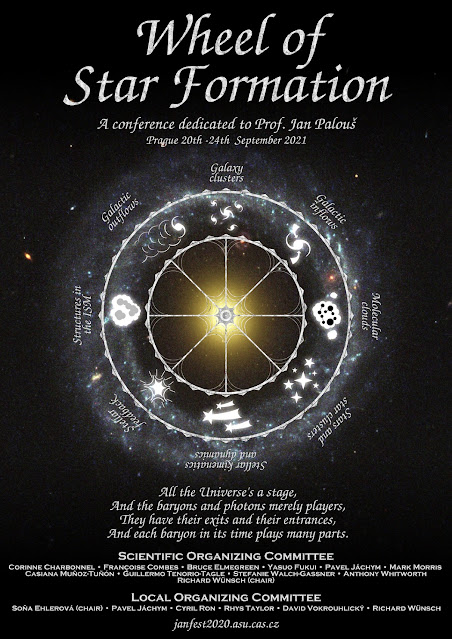
I like this version of the poster best because all the dates are wrong. We started planning it in 2019, so the original 2020 date had to be postponed, and then the second date for 2021 also had to be delayed. Thanks, covid.

The "wheel" concept was chosen as a theme because Jan lives in a converted water mill. And astronomers like to talk about the baryon cycle : how matter is converted between the different phases of stars and gas. The wheel here is an attempt to illustrate this, showing how gas is processed into stars, expelled, and re-accreted and processed by many different mechanisms in many different environments.

Where does my research fit in ? Regular readers already know of my obsession with gas clouds that don't do anything. After all, star formation is rubbish and a waste of precious neutral hydrogen gas, or, as I phrased it in the conference :

Basically the only connection of my talk to the wheel was that it was about the lack of a wheel.

Actually, starless gas clouds are interesting because they're difficult to explain. The most mundane idea is that they're just torn off from regular, bright galaxies. A much more controversial prospect is that they're places where the wheel never started turning, galaxies in their own right where star formation never even got started. And no-one is sure if that's even possible. Some clouds have plenty of stars whereas others, which are otherwise indistinguishable, have none - and we really don't know why.

Normally I do a protracted introduction to the scientific background. Today I'm going to try something different and dive straight into the latest research, so let's see how that works. I'll say only in advance that the main survey I work on is called AGES, the Arecibo Galaxy Environment survey, which looks for atomic hydrogen gas with a great big radio telescope. Everything else I'll fill in as we go.


Everyone's Favourite Gassy Lion

Although my main interest lies in small gas clouds (here meaning "quite a bit smaller than the Milky Way"), I have to admit that the giant features are basically the porn of the radio astronomy world. You can't really not be impressed by features like the Magellanic Stream, spanning more than half the sky yet not even vaguely suspected to exist until the twentieth century. 
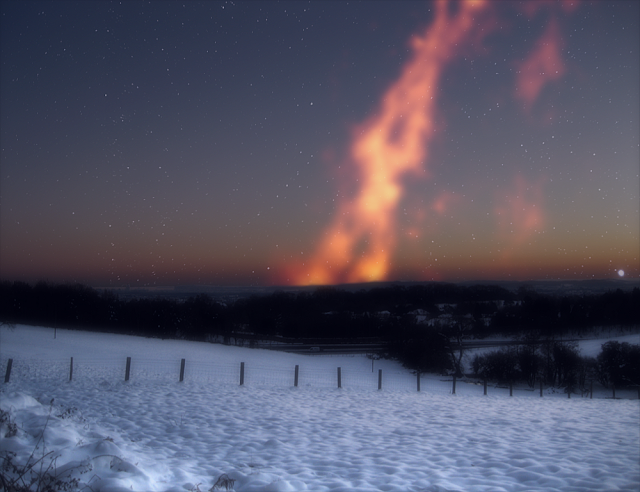
Here shown as it would appear from Cardiff, were it visible to the eye.

Well, I suppose you can be unimpressed, but then I'll look at you as though you have the same towering intellectual and spiritual capacity of a monkey that enjoys hurling its own faeces at other monkeys.

Anyway, the Leo Group harbours one such nerd-bonder-inducing feature : the Leo Ring. It's 200 kpc (650,000 light years) across and has a mass of gas of well over a billion Suns.
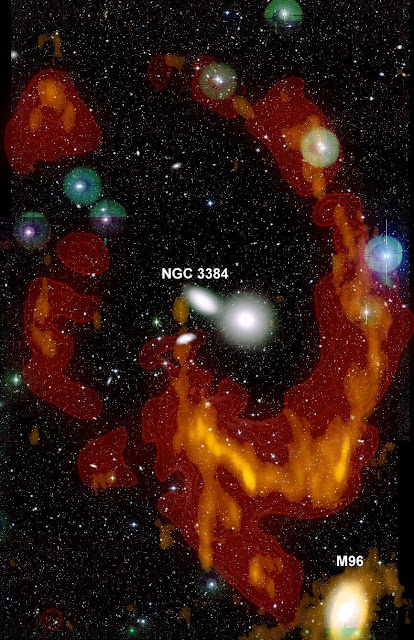
The Ring itself (here shown from an earlier survey) isn't quite a gas cloud that isn't doing anything. Some evidence has been found that there is in fact star formation happening within it, at least in localised areas - though most of it remains dark.

When you're planning a survey with extreme sensitivity, a region like this is a natural target field. I mean, can you think of any reasons not to do a survey of a giant gas ring with better sensitivity than any previous observations ? Of course you can't, because there aren't any.

Or somewhat more prosaically, the deeper the search, the more likely we are to reveal clues to its formation. Gas is never totally stable, and even once removed from a galaxy it can become dispersed or dissolved by a variety of processes. It might collapse under its own gravity to form stars (forming so-called "tidal dwarf galaxies"). Or it might be of such low density and high velocity dispersion that it simply flies apart, fading into undetectability. Or, it might be subject to ionising radiation and so change from nice, easily detectable neutral atomic hydrogen (which we can see with a radio telescope) into ionised gas (which we can't - or more accurately, requires totally different observing techniques).

But the Ring is not the subject of today's paper, not because it isn't awesome, but because we didn't find anything new that leaps out and says, "hey, look at this !". This isn't to say we found no new features in the Ring at all - we did, and some of them might be important. We just didn't find anything that adds anything of immediate value. So our focus on the Ring is now very much on numerical simulations, a project which is going to take a long while to bear fruit. We did, however, find something else that offers a much faster route to publication.


Six Little Clouds

That's right : not only does this region have the giant Ring, but it also has little gas clouds that don't do anything as well ! I could hardly ask for more. In fact I'd better go have a cold shower.
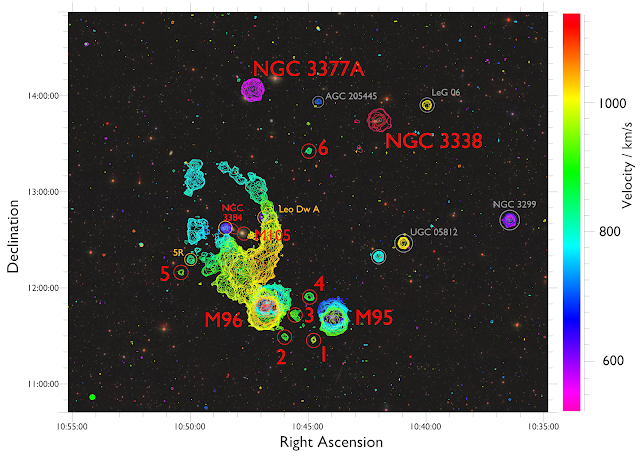
You can see an interactive 3D version of this here.

The really nice thing about radio observations like this is that we can measure what velocity the gas is moving at as well as how bright it is. That's what the colours of the contours show. It doesn't show the full data set though - we limited ourselves to a velocity range corresponding to everything that could plausibly be associated with the Leo Group in which the Ring resides. That's believed to be at a distance of about 11 Mpc (36 million light years).

There's quite a lot going on this plot but really it's pretty simple. The big red labels show the major galaxies and the clouds themselves. Other galaxies are highlighted with grey circles, really just to indicate that we catalogued them and haven't rudely ignored them - we need to know about them, but they're not important for this study. Similarly the orangey circles highlight features we use for a few comparisons but don't examine in any detail.

It's pretty hard to see on a plot of this scale, but every object apart from the six red circles (and 5R) has a clear, obvious optical counterpart. Much like Messier's "not a comet" catalogue, for today's purposes, labelling these is really just to show everyone we know they're there.

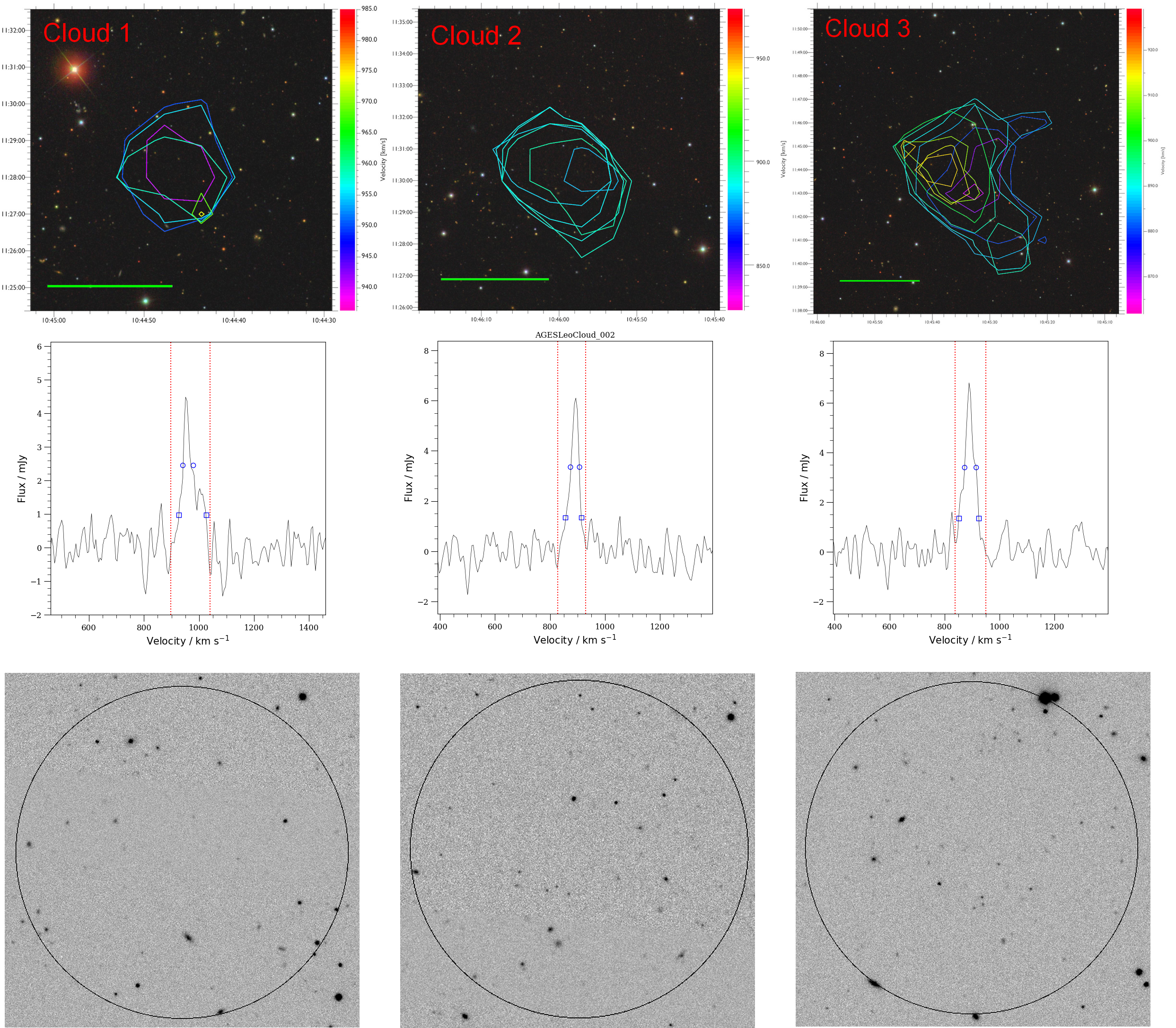
Let's start with the six clouds that form our main sample. We can look at these in more detail :


The top row shows the contours on a pretty-picture optical view, the middle row shows the spectra, and the bottom row shows the optical view in a boring greyscale colour scheme that more clearly shows there's nothing there (with one exception).


In some ways the clouds are all quite similar. Their masses are all a few million times the mass of the Sun, and their line widths are all about 50 km/s. This is a measure of how fast the gas is moving around within the cloud along our line of sight, which we get from the spectra in the above plot. Spectra show how bright the emission is at any given velocity, with the line width meaning the difference between the emission at its highest and lowest velocities. Measuring this is easy enough, but interpreting its meaning - as we'll see - turns out to be quite subtle.

Going purely on where they are, an obvious thing to do would be to wave one's hands and declare clouds 1-4 to be tidal debris (they're right in between two massive spiral galaxies which could well be dukin' it out interacting with each other), cloud 5 to be part of the Ring, and cloud 6 to be a bit odd. And that might turn out to be not so very wide of the mark... but the full complexity is more interesting. 


Six Not-Quite-So-Little Clouds

Even at the basic level the clouds are not as similar as they first appear. Cloud 1 has a line width quite a lot higher than the others, whereas cloud 5 is uniquely close to the Ring and quite a lot less massive than the rest. Clouds 1-4 seem to form a nice little population, but cloud 4 actually does have an optical counterpart.

Umm... but doesn't that mean it isn't a gas cloud that doesn't do anything ? And therefore really boring ?

Yes but no. In every other respect it's similar to the clouds : its mass and line width are typical, and it's found in close proximity to clouds 1-3 as well as being at very similar velocities. If you were given just the gas data, you'd never suspect it was any different to the other clouds. It's a great example of the situation I mentioned earlier, of having some clouds readily forming stars while others just don't.

(It's just about possible that the optical counterpart isn't actually associated with the gas : it could be at a different distance away from us. But if so, this would make it unique among the entire AGES sample so far. We have no other cases of optical counterparts found this close to the coordinates of the gas that didn't turn out to be associated.)

To figure out what's going on we need to dive a little deeper. Here's a zoom-in of the region where clouds 1-4 are found.
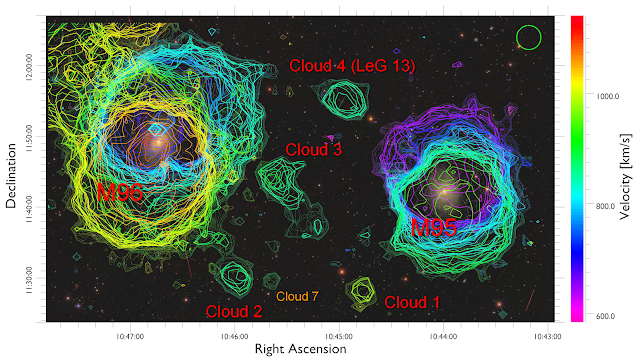
Cloud 7 is a little blob that appeared after smoothing. It may or may not be real, we don't know.

Notice here we have both thick and thin contours. The thin contours come from smoothing the data, which improves our sensitivity though at the cost of degrading our velocity resolution. This was a pretty neat trick (I think it was Robert Minchin who suggested this). See, while you can hand-wavily declare clouds 1-4 to likely be tidal debris, they don't really look all that similar to the classic debris-structures. Simulations have shown for decades that this produces a characteristic tail and counter-tail on the parent galaxy, but that's just not what we're seeing here (in particular, M95 is pretty much undisturbed, apparently sailing serenely through the cosmic chaos raging all about it). And we also noticed that cloud 1 has that higher velocity width. So we thought that maybe if we smooth the cube in velocity, we might discover a larger, more... easily interpreted structure.

Well, we didn't. Why not ?

We don't know. The puzzling thing is that the smoothed contours are different to the standard ones, but not at all in the way we expected. With satisfying irony, the only cloud whose appearance isn't changed by the smoothing is cloud 1, the very one of which we were most expecting to see more extended features !

What actually happens is this. Cloud 1 looks unchanged, as do the big spiral galaxies M95 and M96. Cloud 2 appears to be connected to the spiral galaxy M96 by a narrow tendril, not much resembling a standard tidal feature. Cloud 3 is significantly more extended (some hints of that can be seen in the original data), while cloud 4 also shows some quite strong hints of being more extended as well. And while a new feature, tentatively but unimaginatively dubbed cloud 7, appears, there's absolutely no hint of any really large-scale bridge linking the two spirals, which would have been a "smoking gun" signature of a tidal encounter between them. Indeed, much of their outermost regions look completely unimpressed by everything that's going on around them.

Especially appropriate because dispersion is exactly what we'd expect.

That cloud 4 is a bit more extended is a particular puzzle. We speculated that, being the most massive of the clouds (albeit only very marginally), maybe it was also the most compact and densest. Higher density means more star formation, but actually it looks like its density can't be much different to the others, and if anything is likely to be on the low side. So why is this one forming stars but the others are being a bunch of lazy buggers ?

Again, we don't know. Let's try a different approach.


Six... Totally Unique Little Clouds ?

Remember the line width ? For normal galaxies, this is basically equivalent to rotation speed (if you read the previous post you'll know all about the subtleties of this). But remember, strictly speaking, this is not what it's really measuring. What it actually tells you is the difference between the lowest and highest line-of-sight velocities of a feature - that is, how fast each part is moving towards or away from us.

(Now to be really strict, distance and velocity aren't the same. In principle, a cloud detected at a velocity of, say, 100 km/s could be at a different distance of one moving at 101 km/s even if they were found at the exact same position on the sky. So in theory, each of these "six" clouds could actually be lots of clouds that had all just decided to line up very neatly along our line of sight. But this is fantastically unlikely bordering on silly : on large scales, distance does (famously !) correlate with velocity, so it's a very safe assumption that each of these clouds really is just one feature.)

Unfortunately we can't just simply assume line width represents rotation in all cases. For normal, star-filled galaxies this is a safe assumption, for the most part. There's a very neat relation between the "baryonic" mass (stars + gas) of a galaxy and its rotation speed. This is the Baryonic Tully-Fisher Relation :
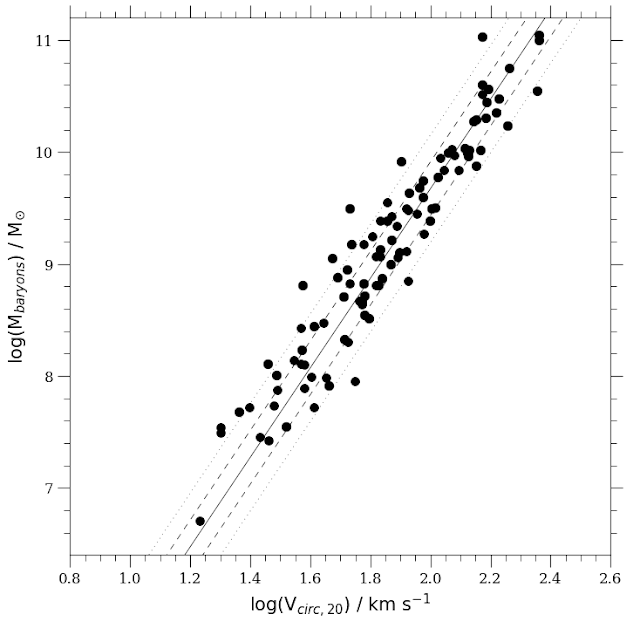
I've simplified this just a tad, removing a few known and explicable outliers and combining a couple of different data sets. The axes are in logarithmic units, with the vertical one being mass and the horizontal one being rotation speed. Dotted and dashed lines show the scatter at different significance levels.

This relation was found for observations which had much higher resolution than the AGES ones, where we can really see that one side of the galaxy is moving faster or slower than the other, giving us a true rotation curve. With our data, we just have to assume the line width represents rotation. But take a moment to just marvel about bloody frickin' impressive this relation is : it holds for galaxies rotating from 15 to 250 km/s, ranging in mass from a few million to a hundred billion times the mass of the Sun.

Opinion is divided as to whether this represents something inexplicable and impressive or monumentally dull, but either way, it's pretty neat.

And then, take another moment to appreciate that making this plot requires a wheelbarrow full of work. I'll simplify here so people don't die of boredom, but if you want the full, grisly details, see the previous post.


Right, are we all impressed enough yet ? Good. Let's continue.

Line width is definitely a good measure of rotation for normal galaxies, because we see the width gives a stonkingly similar location on the BTFR plot to true rotation velocity. When we then add in the dark clouds though :
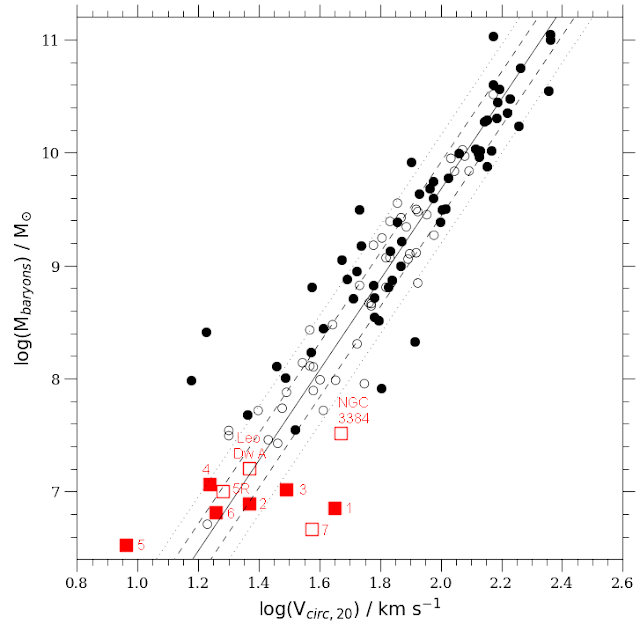
Here I've split the galaxies back into their original samples : filled black circles show the data from AGES (now also including some outliers), while open black circles show ones with proper rotation curves. Red filled squares show the main Leo clouds while the open squares show other selected features in the same region.

Which to be honest is not a lot of help, and maybe makes things if anything more confusing as to the clouds...

There's a very simple thing that might help to keep in mind as things about to get worse. Normal, rotating galaxies are proven to lie on the BTFR, with only rare exceptions. So something on the BTFR, naively, can be presumed to be a galaxy. Conversely, there's no reason at all to expect unstable, non-rotating bits of fluff to follow the BTFR, so anything not following the standard relation is more likely to be debris. Keep that in mind as your anchor point.

Let's take this one step at a time. Ignore everything else and have a look at clouds 1-3. Since these are right between the two big spirals, it seems a very good bet that they're tidal in origin, even if they don't look much like typical tidal features. 

Now cloud 1 does seem to play ball. It lies well outside the general scatter of this BTFR: if this were rotation, it would be far higher than you'd expect for a galaxy of this mass - which would be absolutely consistent with it being unstable tidal debris that's in the process of dissolving. Hooray !


Except... maybe not. The thing is, cloud 1 is unresolved in our data, showing no signs of any extensions as we'd expect it to have if it was debris. But cloud 2, which does show such extensions, is in good agreement with the BTFR. So cloud 1's shape doesn't fit with a tidal origin, but its velocity does, whereas for cloud 2 it's the exact opposite. This is rather confusing.


Maybe this is just a bit of an odd fluke ? Well, let's try cloud 3 then... ahh, no help there. This one is much more debris-like after smoothing - it's the most extended of all - but though it too has a higher velocity width than the BTFR predicts, the difference is only marginal. It's by far the most extended but arguably still consistent with the general scatter in the BTFR. 

Okay... cloud 4 ? Here things are a bit better. Having an optical counterpart and therefore quite probably just being a normal galaxy, this one agrees with the BTFR quite well. So that's something. And so does the very faint (but definitely a galaxy) Leo Dw A. Hooray ! The problem is that so does cloud 6, and also 5R (a feature most likely just part of the Ring), which don't have optical counterparts.

Now there's an exciting possibility for cloud 6 which I'll get back to soon. But if it's unstable debris, as cloud 5R almost certainly is, there's absolutely no reason to expect it to follow the same relations as for rotating stable galaxies. And some clouds known from other surveys (not shown here) also do the same thing. 

In short, the clouds don't really match our expectations of the BTFR very well at all - they're not totally at variance with it, but they're not in great agreement either. The take away message is basically this :


Those other extra features (the open red squares) aren't any help either. Cloud 7 is offset, but we're not even sure if it's real, while the cloud near NGC 3384 (a big elliptical galaxy at the centre of the Ring) is somewhat deviant but likely has a lot of measurement errors, so its velocity width is probably overestimated.


Six Sensitive Little Clouds

Hang on, there could be an easy way of of this wretched mess. Forget the physics for a moment and try instead the statistics. What I mean is, we could be having an unpleasant attack of a selection effect. 

It looks as though most features follow the BTFR or are only marginally offset. But maybe we only find clouds in this region of the BTFR because that's the only place we can find them, and they're just extreme examples of a population which is by and large normal. This is possible. After all, we do find a couple of clear outliers.

There's a few different effects at work here. For a cloud of any given mass, it's easier to detect if it has a smaller line width - all its flux is "bunched up" and appears brighter. Similarly at any given line width, clouds of higher masses are easier to detect. But at some point we expect the mass to be so high that we should have star formation*, so they'll no longer be optically dark. Fortunately we can quantify all this, and we find that...

* Strictly speaking it's density rather than mass that matters, but this is something we can account for.

There's really not much constraint on the clouds to be in this part of the BTFR at all. Bugger.

It turns out that we can easily detect clouds of the same mass with much wider widths than these, and other clouds are known which are a hundred times as massive and not forming stars. So width doesn't limit which ones we can detect, and the requirement that the clouds aren't star-forming doesn't impose any real constraint either.

Right. Okay. That didn't help at all then.

There is another caveat though. We've seen that interpreting line width can be complicated, but actually, measuring it isn't quite so straightforward either. It isn't like measuring the peak brightness - there isn't one unique width value that gives you the right answer. Instead we have to choose which conventionally-accepted procedure we want to adopt. Normally we measure the width at either half or a fifth of the peak brightness level, and there are calibrations we can apply to convert these values to true rotation speed. But naturally, this isn't perfect. And likewise, correcting the stellar mass of a galaxy is subject to a host of choices as to which method of converting brightness to mass one happens to prefer.

All this means that there is some considerable scope for shifting the best-fit line of the BTFR, as discussed in depth previously. I'm only showing this particular version of the BTFR here because it's the best and most carefully-calibrated version, but it would be going a bit too far to pronounce it as definitive. In any case, we could shift the line at least a little bit, changing which ones agree with the BTFR and which ones don't - but this is a pretty weak effect, and definitely doesn't solve everything.


Six Sexy Little Clouds ?

So let's presume this version is correct or we'll get nowhere. If statistics can't help us, it's time to bring in the physics.


For this, let's shift to cloud 6. This one is pretty much in the middle of nowhere. None of the galaxies near to it have signs of extensions, and they're anyway at such different velocities that they're likely at very different distances away from us. So it doesn't look anything like classical tidal debris, and its line width is consistent with being a perfectly normal galaxy on the BTFR... yet it has no visible stars

Could this be one of the semi-mythical starless "dark galaxies" of song and story ? Such objects would solve a huge, long-standing problem in cosmology, that simulations predict far more galaxies than surveys detect. So this would be a Big Deal if this was the case.

The answer is... yes ! It could. Well, maybe. To be strictly accurate, I would phrase it thus : the dark galaxy hypothesis is a valid explanation that should not yet be rejected. I'd be willing to go a little further and say that it's hard to see how cloud 6 could have formed by tidal encounters, there being no obvious signs of any features that gave rise to it. The Leo Ring is miles and miles away, and it's damned hard to see what sort of event could create a giant, coherent, massive arc of material and also one teeny-tiny compact little blob that's so well-separated from it.

Of course this needs to be tempered. Without a full explanation of the formation of the Ring, we can't say for sure that it isn't just some weird outlying blob. Or we could look at it the other way around, and say that if we assume it is some outlying blob, this gives us a powerful constraint on the formation of the Ring. Either way, it's a valuable blob, to be sure.

If we can't reject the dark galaxy hypothesis for this cloud, what about the others ? Well, now I'm afraid I need to take the stabilisers off and contradict what I said earlier. Just because something is deviant from the BTFR doesn't guarantee it's not a galaxy. There are known examples of very massive galaxies that rotate too quickly, of very faint galaxies which rotate too slowly, and we have good reasons to expect there to be more scatter in the BTFR than we actually see.

And, if line width represents dispersion (i.e. expansion) instead of rotation, then the objects with the highest line width should be the hardest to detect because they'll become undetectable most quickly. This makes rotation (which implies dark matter) actually a much better explanation in these cases, which is something I've previously shown at length - with rotation, you can be stable at any velocity width indefinitely. For galaxies, the secret to immortality is just to spin round really fast.

Disclaimer : spinning yourself or your pets won't help you live longer.

So alas, there's no clear, take-home message from this. The clouds simply don't fit a nice neat narrative, which is why the high-school description of science as a process of hypothesis testing is fundamentally flawed. Far better to remember that's a much more complex network of exploration and examination. Depending on your point of view, you could easily present the data to favour or disfavour whatever you need it to.

With that in mind, here's how I'd sell it. It's my paper, after all.


Summary and Conclusions

These nice little clouds have similar masses and line widths, but even among this small population there's no small degree of complexity. Let's start with a summary of each of the clouds. 
  • Cloud 1 is between the two big spirals. It has much the largest velocity width, but smoothing didn't reveal it had any kind of extended component. Its location and line width suggest a tidal formation mechanism, but its lack of extension doesn't fit this view.
  • Cloud 2 is between the two big spirals. It has a typical velocity width and smoothing reveals it has an extended "tendril" connecting it to one of the spirals. Its location and extension imply a tidal origin, but its agreement with the BTFR is unexpected, and its extension doesn't really fit the general expectation for tidal debris.
  • Cloud 3 is between the two big spirals. It has a typical velocity width and smoothing reveals it is significantly extended, though not connected to either galaxy. It is marginally deviant from the BTFR, and generally just ambiguous all-round.
  • Cloud 4 is between the two big spirals. It has a typical velocity width and is at a similar location to clouds 1-3, but uniquely has a clear optical counterpart. Its mass is only marginally greater than the others and smoothing reveals it may be slightly extended, so its density doesn't seem likely to explain why it alone has formed stars. It follows the BTFR of normal galaxies.
  • Cloud 5 is close to the Ring, and it's hard to tell if this is really a discrete feature or not. Smoothing revealed no signs of anything extended.
  • Cloud 6 is as isolated as anything can be in this region. It lies on the the BTFR for normal galaxies but, like the other clouds, has no optical counterpart. The galaxies nearest to it on the sky are actually likely to be at quite different distances, and none of them show signs of extensions anyway.
So the clouds differ in terms of their environment, line width, optical emission, and extension. Six clouds that vary in four different ways... that's so much diversity they're practically woke.

Now the optical counterpart to cloud 4 is clear enough, though it is quite faint. But thanks to the presence of the Ring, this region has been subject to a host of much, much deeper surveys, and none of them have reported anything at all at the positions of the other clouds. So if any of the other clouds do have optical counterparts, it's likely that they're an awful lot fainter. It's just not at all obvious why one cloud should be bright and the others aren't.

It's tempting to say that cloud 4 is a normal galaxy that just happens to have wandered in to the mess around it. That may be so. It could just be an innocent bystander that's wandered into a bad neighbourhood, and is going to get a nasty surprise when it realises some astronomers are gossiping about it behind its back.


But I'd say it's at least viable to say it might be a cloud that's had it's star formation triggered as it's wandered in - it looks so similar to the other clouds, it just seems weird to think this is a coincidence. Or perhaps the opposite is going on. Maybe it's not the first but the last cloud to have had its star formation episode, with the others having already faded into their current darkness. We really don't know.

With the clouds we found in an earlier AGES study of the Virgo cluster, we used their line widths to try and constrain their evolution, and we did the same here. If we assume the line width is how fast the clouds are dispersing, we can calculate how fast they'd have to have travelled to reach their current distance from their nearest galaxies while still being detectable. And in Virgo we found that this was so fast as to be really quite implausible.

Annoyingly the Leo clouds are on the margins. Their line widths aren't so high, so they wouldn't have had to have moved so fast. It would be quite a bit higher than expected in a group like this though, and that the clouds are at nearly identical velocities to the other galaxies speaks against this. But it's not a strong constraint, especially as we have no idea how fast anything is moving across the sky. In short, the line widths are consistent with the clouds being both tidal debris and dark galaxies, which isn't much use.


Here's my best guess. Clouds 1, 2, 3, 5 are all unusual forms of tidal debris, relating to the formation of the Leo Ring, with the bright spiral galaxy M95 not being involved at all. They may or may not be in a state just before or after a period of star formation, depending on whether cloud 4 is a normal galaxy or another cloud. Cloud 6 might be some long-lived tidal debris from some other, unrelated interaction, with the rest of its parent stream having already dispersed, though the possibility that it could be a dark galaxy needs to be given serious consideration.

The elephant in the room is that bloody great Ring, of course. It does seem to be connected to the spiral galaxy M96, but it almost looks like it's just superimposed, and doesn't represent any major damage done. And its overall structure is just frightening complex. Very plausibly, it involves five interacting giant galaxies, which means a parameter space which is hideously vast. Is it crucial or irrelevant ? We just don't know.
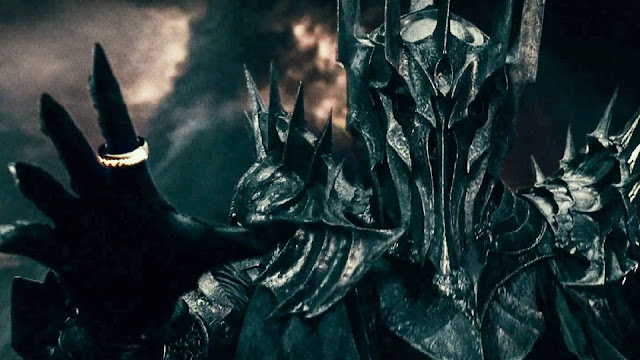
Humanity has a love-hate relationship with rings which is so powerful that it's literally mythical.

So what're we going to do this figure this out ? 

Oh, pish, y'all know the answer, it's a cliché even more entrenched than magical rings. Come on, all together now :

WE

NEED

MORE

DATA !!!!

In this case we're going to need more data from both observations and simulations. We need to figure out ways that stupid Ring could have formed, and then we need to test it all against observational data. Our clever tricks to increase the sensitivity have associated penalties, so really we just need better original data.

Without Arecibo this is hard. So my idea is to write to Jeff Bezos and pitch a sequel-prequel series : Radio Rings of Power. They're the size of galaxies and don't do anything, but I'm sure if we throw in enough sex and violence they executives will beat a path to our door. Stay tuned.